Canaan Kendryte K230D: The First Mass-Produced AIoT Chip Based on the New 32-bit RuyiSDK

In the previous article, we introduced "The XuanTie Team and PLCT Lab Jointly Release a New 32-bit Product-Grade Open-Source Toolchain and Linux Kernel". This article brings the latest productization progress of the new 32-bit (RV64ILP32) effort: the Canaan Kendryte K230D.
Last year, Canaan launched the K230, based on the XuanTie C908, the world's first 64-bit RISC-V AIoT chip with VECTOR 1.0 support. This year, Canaan Kendryte introduced the more highly integrated K230D AIoT chip, reducing memory from external 256MB/512MB to 128MB in-package. Software built on the LP64 ABI had too much memory overhead for the K230D, while the new 32-bit technology improves both memory and cache efficiency. PLCT Lab and the XuanTie team worked together to build a new 32-bit RuyiSDK for the K230D, achieving the first real product deployment of the new 32-bit stack for AIoT devices. Compared with the previous LP64-based SDK, the new 32-bit SDK reduces memory overhead by 30% and improves linked-list traversal performance by 20%, balancing both cost and performance.
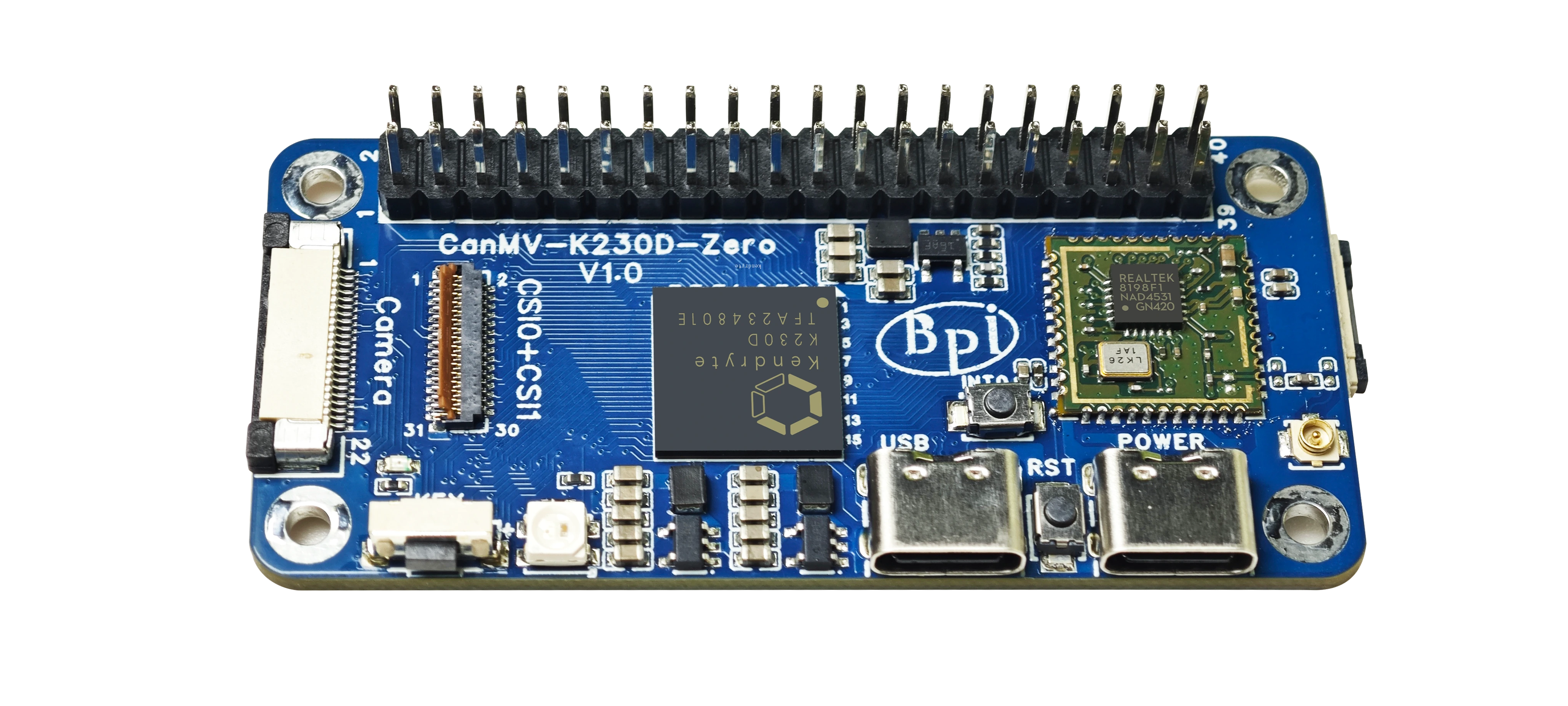
K230D RUYISDK Overview
The DAMO Academy XuanTie team, together with Canaan and PLCT Lab of the Institute of Software, Chinese Academy of Sciences, brought the new 32-bit technology to the Banana Pi open-source community's BPI-CANMV-K230D-Zero development board and integrated it with PLCT Lab's RuyiSDK to provide a more convenient user experience:
- Linux kernel upgraded to 6.6, along with toolchain upgrades
- A new 32-bit root filesystem and LVGL support
- VECTOR-based graphics acceleration
- Dual-system support for Linux + NuttX, with flexible big/small core switching
- Support for both the traditional 64-bit and the new 32-bit system configurations
Kernel configuration
| Traditional 64-bit (RV64 LP64) | New 32-bit (RV64 ILP32) | |
|---|---|---|
| Kernel build command | make ARCH=riscv k230_defconfig all | make ARCH=riscv k230_defconfig 64ilp32.config all |
The default configuration differs by only two lines:
CONFIG_ARCH_RV64ILP32=y
CONFIG_32BIT=y
Memory Comparison
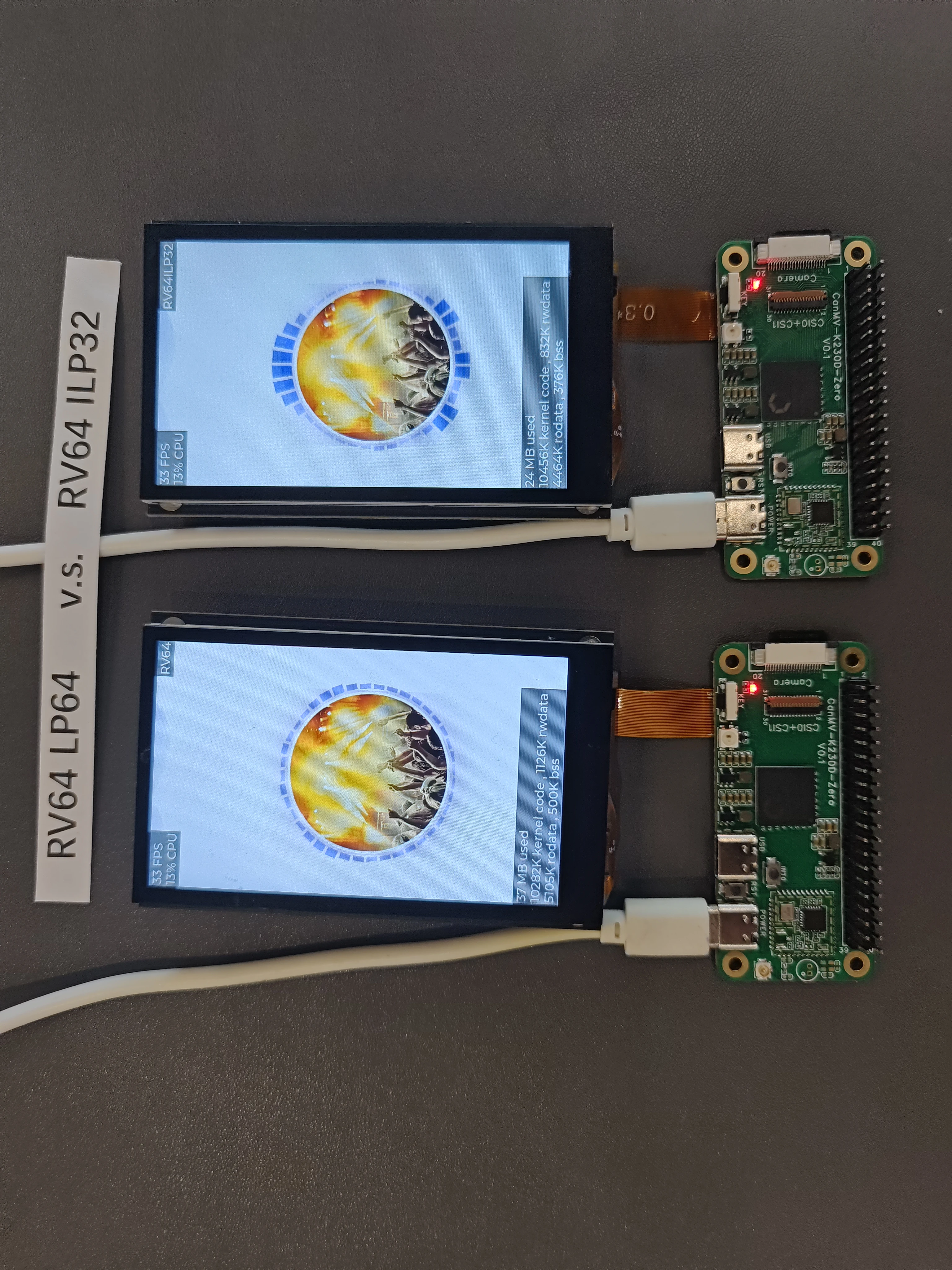
The video and image below compare LVGL running on the traditional 64-bit build (left) and the new 32-bit build (right):
| Dynamic Memory Comparison | Traditional 64-bit (RV64 LP64) | New 32-bit (RV64 ILP32) |
|---|---|---|
| used | 37MB | 24MB |
| Static Memory Comparison | Traditional 64-bit (RV64 LP64) | New 32-bit (RV64 ILP32) |
|---|---|---|
| kernel code | 10282KB | 10456KB |
| rwdata | 1126KB | 832KB |
| rodata | 5105KB | 4464KB |
| bss | 500KB | 376KB |
Compared with the traditional 64-bit build, the new 32-bit RuyiSDK greatly improves memory efficiency and avoids memory waste in K230D productization.
Performance Comparison
Because pointer data types in LP64 are twice as large as in ILP32, LP64 makes less efficient use of cache. The table below compares doubly linked-list traversal performance on the K230D:
Doubly linked-list traversal (4000 nodes, traversed 50,000 times)
| First run | Second run | Third run | Fourth run | Fifth run | Average execution time | |
|---|---|---|---|---|---|---|
| Unit: nanoseconds | Unit: seconds | |||||
| LP64 | 3872221628 | 3420261850 | 3774494961 | 3539484998 | 4034940590 | 3.728280805 |
| ILP32 | 2614749257 | 2261891517 | 2680216665 | 2894499368 | 2847282036 | 2.659727769 |
The results show that ILP32 significantly outperforms LP64 in linked-list traversal.
Related Resources
K230D RuyiSDK: https://github.com/ruyisdk/k230_linux_sdk
For image building details, see: https://github.com/ruyisdk/k230_linux_sdk/blob/dev/README_zh.md
K230D usage guide: https://ruyisdk.org/docs/k230d/intro
Closing Remarks
Unlike earlier architecture efforts focused on user space, such as ARM, x86, MIPS, and SPARC, the current new 32-bit approach provides an ILP32 ABI for the privileged mode of the RV64 architecture, based on the RVA20/22/23 Profiles. This is a path that has not been explored before. Since the release of the new 32-bit toolchain and Linux kernel in March 2024, this work has now reached product deployment on the K230D, cutting memory overhead by 30% and substantially improving cache efficiency. These results further demonstrate the industrial value of the new 32-bit approach.
We warmly welcome developers to participate in the development and improvement of the new 32-bit stack, contribute suggestions and feedback, and help drive it forward. We are committed to building a healthy and active open-source community, continuously investing resources and effort to ensure the stability and reliability of the software while steadily improving its functionality and performance. We also call on more hardware vendors to join this effort and advance the development and innovation of new 32-bit embedded systems together.
About Us
● RuyiSDK is an open-source project initiated by PLCT Lab. It aims to provide RISC-V developers with a full-featured, all-in-one development environment, covering the complete toolchain from compilation and debugging to simulation, with planned support for mainstream RISC-V hardware platforms.
● The DAMO Academy XuanTie team has continued to invest deeply in RISC-V technology research and ecosystem building, launching a series of XuanTie processors that cover the full performance range from low to high end. XuanTie actively embraces open source and open innovation, and has gradually built a RISC-V-centered ecosystem, working with partners to advance integrated hardware-software development across chips, development tools, operating systems, and application solutions. Its goal is to accelerate the adoption of full-stack RISC-V technology in multiple domains and help realize the interconnected world of the intelligent era.
● Canaan Inc. (NASDAQ: CAN) is a leading high-performance ASIC chip design company with a diversified "blockchain + AI" strategy. Its business spans high-performance ASIC computing chips and equipment, as well as AI chip and product development. As a Nasdaq-listed company, Canaan was the world's first "blockchain stock" and also the first Chinese AI chip company with independent intellectual property to list in the United States. Its vision is to improve the efficiency of society and enhance the way people live.